
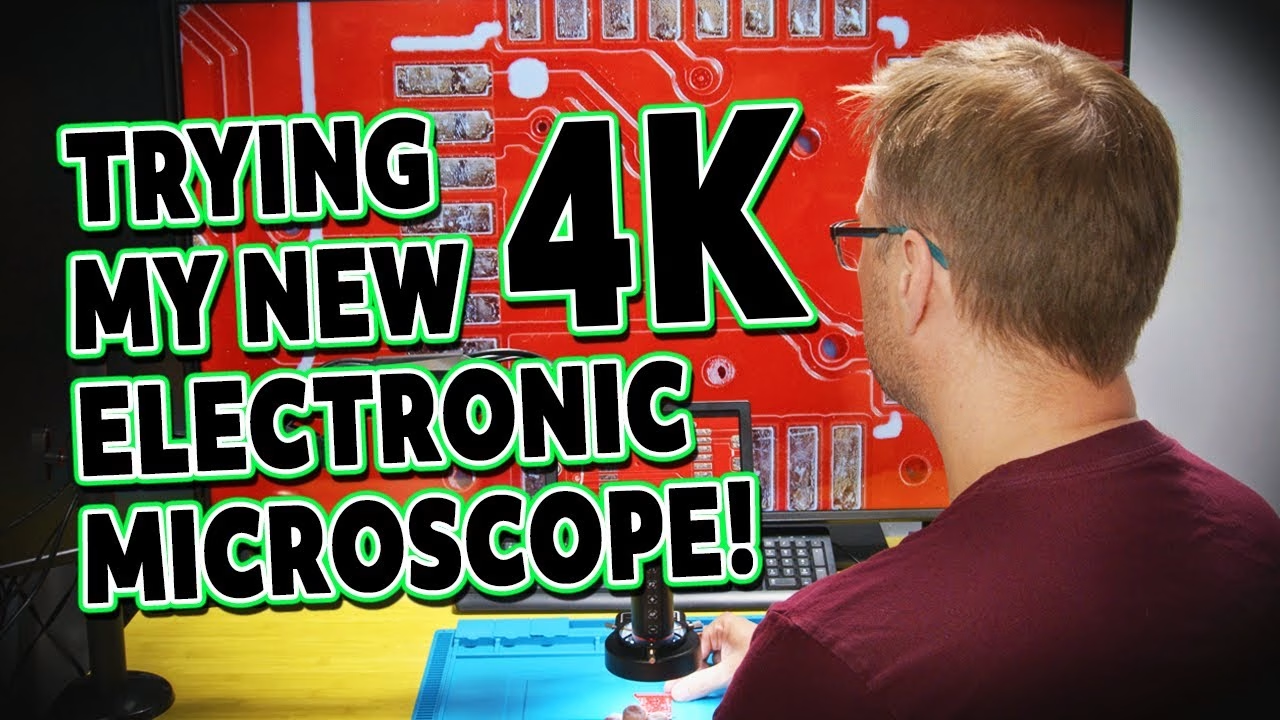
My existing Tomlov microscope has been great for image quality, but its working space is too small: anything bigger than a small board and I can’t comfortably reach every component. So when Tomlov offered me the TM4K-AF Flex for review, I jumped at it. The name sums it up: a 4K sensor, a flexible arm for much larger subjects, and autofocus. Here’s how it goes together, what the controls do, and how it copes with real PCBs.
Assembling the TM4K-AF Flex
Everything was well packed and feels robust. For a permanent install I’d screw the plate to my workbench, but my bench is too thick for the clamp and I’m about to move out of this space, so it went on my streaming PC table, which is a bit wobbly. Any shake you see in the footage is the table, not the microscope. A silicone work mat is included too, which is a nice touch.
- The clamp and mounting pole bolt together, with a locating pin as well as the bolt.
- The flex arm has plenty of reach, built-in cable tidies, and a clamping sleeve that slides over the pole for large height adjustments.
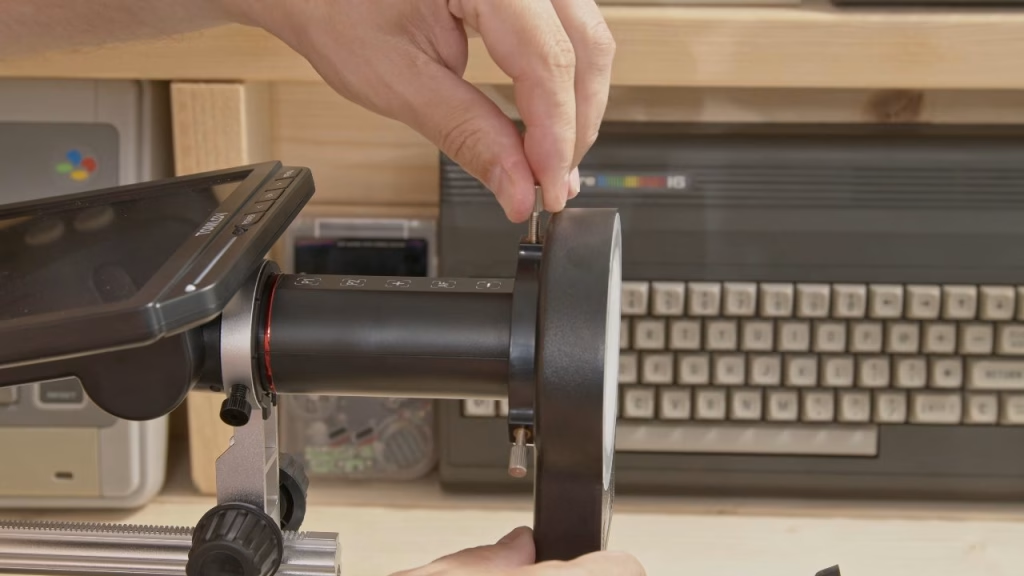
- At the far end there are two directions of adjustment and a threaded hole for the microscope jig, which locks with a black wheel and a tensioning collar.
- Geared adjustment and a locking knob give another degree of movement, then the scope slides into its holder and tightens up.
- The ring light attaches the same way, below the red line on the scope (under the buttons).
Ports, power and recording
The big reason I wanted this one is the 4K mini HDMI output. I can feed it straight into a capture card on my streaming PC and record in OBS, which will be perfect for my planned videos on fine-pitch SMD soldering. A mini HDMI to full-size cable is included, though it wasn’t long enough to reach my capture card, so I used an adapter and a standard cable.
It can also take stills and record video to micro SD (a card is included, in one of those slots you need Cruella de Vil fingernails for), though I’m always dubious about the quality of onboard recording. The USB-C socket charges and powers it, and also connects to a PC or Mac as mass storage or a webcam-style UVC source. There’s a 5V output for accessories such as extra lights, and a built-in battery, which makes more sense with the portable stand than on an arm. My review unit came direct from China with a two-pin plug, so I powered it from my power strip’s USB socket; you’ll get the right supply for your region.
How good is the autofocus?
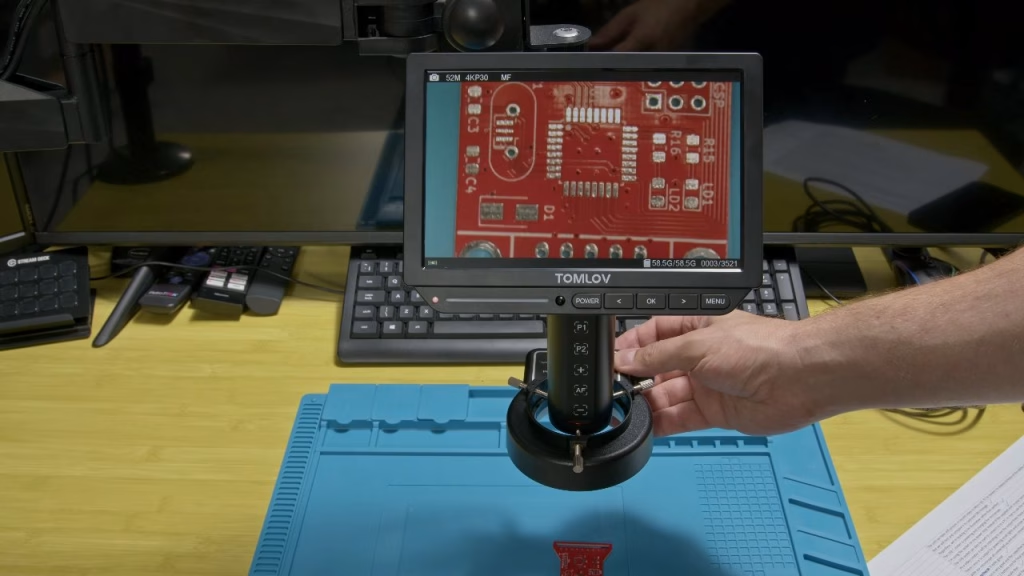
Very good, and the capacitive buttons are snappy. P1 and P2 store focus presets: focus, long-press one, and pressing it later snaps straight back without hunting. There are also manual focus buttons for fine tuning (on my old scope I had to move the whole thing with knobs). The power button matters, because the remote can turn it off but not on. OK takes a still or switches modes, and left and right zoom digitally. I was surprised how good the digital zoom is: smooth, and not noisy.
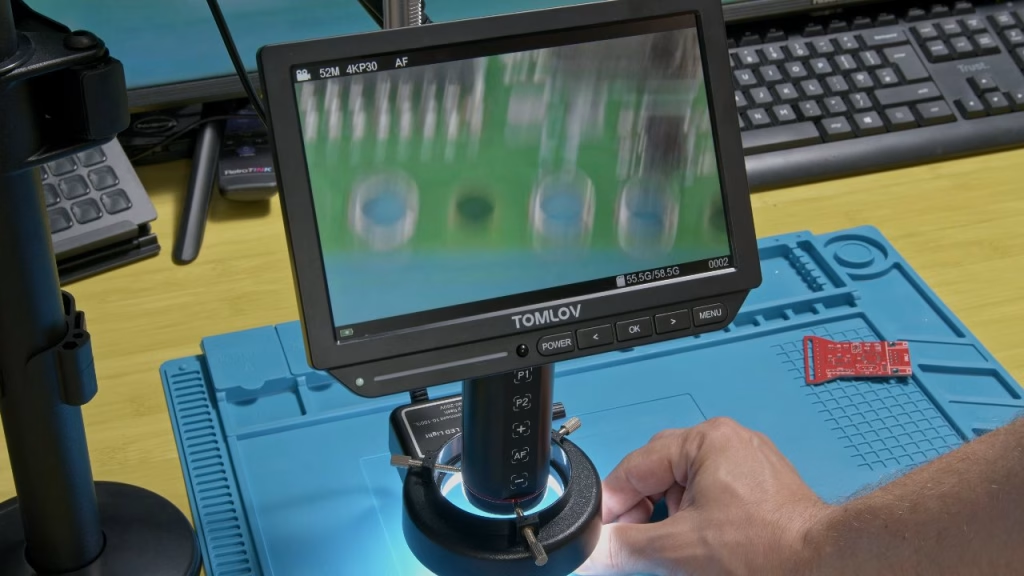
Long-press the AF button for constant autofocus. It seems to work on scene change detection, hunting for the highest contrast point whenever the view changes, so you can move around a populated board and stay in focus. On boards full of components, refocusing by hand gets tiring fast, so I found this mode incredibly useful. The remote is self-explanatory, although its right button turns my TV off.
Built-in LEDs versus the ring light
The scope’s own LEDs, controlled by a capacitive strip, sit close to the sensor and throw a lot of glare off shiny PCBs. That’s handy for spotting solder bridges and broken tracks, but not much else. The ring light has its own controls and gives much softer, indirect light, which will be superb for soldering videos.
Testing it on PCBs
Moving a board around under the ring light, the image is smooth with little to no noise or motion judder. I was nowhere near maximum zoom; this is the sort of magnification I’d use for SMD work. Looking over a board I’d soldered with the old scope, it also showed me a mistake I’d made. The less said about that the better.
Is the Tomlov TM4K-AF Flex worth it?
For me, yes. It’s a really good tool for the price and a solid upgrade for the channel: the flex arm solves my space problem, the autofocus and presets save a lot of fiddling, and the HDMI output means I can finally film how I do fine-pitch SMD soldering. Thanks to Tomlov for the scope. At the time of the video there was a time-limited 10% code, 10TM4KFlexAF, and here are the links (not affiliate) for the UK and US.
Related
See what else is on my bench in my top 13 tools for fixing stuff, and for the kind of work a microscope helps with, identifying and repairing dry or cracked solder joints and removing SMD can capacitors without hot air.
Leave a Reply